Pages

Welcome, 77 artists, 40 different points of Attica welcomes you by singing Erotokritos an epic romance written at 1713 by Vitsentzos Kornaros

Showing posts with label mario monti. Show all posts

Friday, July 6, 2012

In Greece, a Bold Plan to Solve the Debt Crisis


In Greece, a Bold Plan to Solve the Debt Crisis
New York Times
The administration's policy platform, outlined by the prime minister, Antonis Samaras, in a speech to Parliament, calls for selling off government assets and reducing state spending.


READ THE ORIGINAL POST AT www.nytimes.com

Monday, July 2, 2012

Mitigating Merkel's Mischief


Telegraph.co.uk

Mitigating Merkel's Mischief
Huffington Post (blog)
Europe was actually on the road to a slow recovery in 2009, until hedge funds began attacking Greek government bonds and Greece's neighbors did nothing. This process followed the disclosure by the newly elected Greek socialist government in October ...
Euro deal leaves deep divisions, lingering questionsmsnbc.com (blog)

all 1,067 news articles »

READ THE ORIGINAL POST AT www.huffingtonpost.com

Robert Kuttner: Mitigating Merkel's Mischief

Merkel, characteristically, still opposes any respite for the suffering Greeks. It is up to the rest of Europe to isolate her again so that she can reverse course citing changed circumstances. Nor is Merkel willing to seriously rein in the financial speculation against government bonds that turns moderate budgetary problems into dire crisis. This, too, will take the resolve of wiser leaders. Until German reunification in 1990, there was a delicate balance in the European Union, in which Germany was contained within a broader democratic Europe. Germany was an economic powerhouse, but was appropriately self-restrained politically. Given German history, this was only prudent. With reunification, Germany not only became even more potent economically, but began throwing its weight around politically. As Merkel keeps proving, this was not a good idea. The rest of Europe's leaders have now restarted the necessary project of containing German influence again, and not a moment too soon.

READ THE ORIGINAL POST AT www.huffingtonpost.com

Wednesday, June 27, 2012

Merkel rebuffs pleas for debt action on summit eve

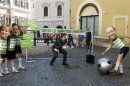
Demonstrators wearing masks depicting Merkel, Rajoy, Monti and Hollande, pose as they simulate playing a soccer match to protest against the euro zone debt crisis, in RomeBERLIN/MADRID (Reuters) - On the eve of a crucial summit that could determine the future of the euro zone, German Chancellor Angela Merkel brushed aside increasingly shrill calls from Spain and Italy on Wednesday for emergency action to lower their soaring borrowing costs. European Union leaders go into the two-day meeting beginning on Thursday evening more openly divided than at any time since a still-widening debt crisis erupted in early 2010 after Greece revealed its deficit and debt were far higher than reported. ...


READ THE ORIGINAL POST AT news.yahoo.com

Microsoft's Greek offices attacked by armed arsonists

• Software firm's Athens headquarters badly damaged
• Italian statisticians stage sit-in pay protest
• Greek restaurant workers hold 24-hour strike

Microsoft's Greek headquarters were attacked by arsonists and government statisticians in Italy staged a sit-in pay protest as anti-austerity demonstrations continued to sweep the eurozone.

Microsoft's Athens offices were seriously damaged after armed arsonists drove a stolen truck through the entrance in the early hours of Wednesday morning, and then set fire to it. The office, where more than 100 people work, will be shut for the day.

"It was very lucky that no personnel were in the building at the time," said a police source. "We've had drive-by attacks but nothing like this. In style it is unprecedented."

The ground floor of the US software giant's office suffered heavy damage, which the fire brigade estimated about €60,000.

Arson attacks against banks, foreign firms and local politicians have become more frequent in Greece in recent years amid public anger against the government's harsh austerity policies. Police said it was too early to say who was behind the latest attack. In February, a small bomb was left on an empty subway train in Athens, which a far-left group fighting the austerity measures claimed responsibility for.

In Italy, the protest by number crunchers delayed the release of Italian business morale data, as some 42 statisticians, researchers and computer technicians from ISTAT, Italy's national statistics office, stormed the room where the data are normally handed out, and held a labour union meeting.

Francesca Taratamella, who works in the national accounting department, said staff were protesting against the stats office's failure to award promotions to those who were entitled to them. She said she and her colleagues had been given extra work and responsibilities without any promotion or increase in wages.

"More in general, we are here to lament the freeze on new hires, on salary increases and on promotions … in the public sector," she told Market News International.

Italian prime minister Mario Monti's popularity has waned as he is implements painful austerity measures.

The staff protest at ISTAT meant the business confidence figures for June were published half an hour later than scheduled. When they were finally released, they showed a surprise improvement in morale in June, with the index rising to 88.9 from 86.6 in May.

Back in Greece, restaurant workers called a 24-hour strike for Wednesday to protest against wage cuts and other austerity measures imposed by the government. The strike comes in one of the key months for tourism, the country's biggest industry.

"Employers are blatantly using the avalanche of measures, which are crushing the human and social rights of workers, to violently demand submission to their demands," the Panhellenic Federation of Catering and Tourist Industry Employees said on its website.


guardian.co.uk © 2012 Guardian News and Media Limited or its affiliated companies. All rights reserved. | Use of this content is subject to our Terms & Conditions | More Feeds


READ THE ORIGINAL POST AT www.guardian.co.uk

Sunday, June 24, 2012

Hollande's pro-growth rhetoric won over France. But what about Merkel? | Jonathan Fenby

François Hollande must now find if his rhetoric can translate into a left-leaning, pro-growth agenda for the eurozone

François Hollande has been a busy man since he won the French presidency on 6 May. But he still has all to play for on the most important field – Europe – particularly after the lack of progress at his summit with the leaders of Germany, Italy and Spain in Rome on Friday.

In the past six weeks "Mr Normal" has constituted a new government, seen his Socialist party win an overall majority in legislative elections to add to its already formidable grasp on regional decision-making, journeyed to the United States to meet President Obama and join a Nato summit, gone to Mexico for the G20 meeting, and met an array of European leaders to discuss the euro crisis. All the while he has been putting through the first planks of his campaign promises, including the lowering of the pension age to 60 for some workers, a cap on earnings of bosses of state companies, and the reduction of ministerial salaries as he tries to make the fifth republic a more down-to-earth ruling system to which ordinary people can relate.

But all this is mere preamble to the new president's main task – the effort to combine renewed growth with cuts in the government deficit as the spearhead of a new European approach that will stress economic expansion rather than austerity. This week, starting with the German-French-Italian-Spanish summit in Rome, will test whether his rhetoric can be translated into a left-leaning, pro-growth agenda for the eurozone to pull it out of its seemingly endless crisis.

The new Socialist administration in Paris believes that Hollande's policies will muster a sufficient head of steam to overcome German reservations at the European summit in Brussels at the end of this month. It hails any mention of the word "growth" by leaders in other EU countries as a sign that Paris has the wind in its sails. At last, a government of the left claims to have come up with an answer to the drawn-out eurozone crisis that goes beyond belt tightening.

That sounds very attractive, especially given the way that the austerity preached from Berlin offers a bleak future for many European nations. But the room for hope looks considerably less than optimists in Paris might believe. We are not back in the heady opening months of the previous Socialist president, François Mitterrand, who declared in 1981 that there was nothing wrong with dreaming. But, as with Mitterrand, reality has a nasty way of intruding on even the most pleasant of reveries.

The decision at the Rome summit to launch a €130bn growth package consisted largely of the re-bottling of old funds in supposedly new bottles, including use of unspent budget structural funds. The post-summit press conference showed up once more the divergence between Hollande and Angela Merkel. Financial markets will not be impressed given the continuing tide of bad news.

Though coming off the heights reached last week, Spain's medium-term borrowing reached its highest level since the euro was introduced at the beginning of this century, and an audit showed that the country's banks would need up to €62bn in additional capital to meet adverse conditions. The unelected domestic political honeymoon of Mario Monti, the Italian prime minister, is over as tax increases and reductions in pensions fuel recession, and both trade unions and business are unhappy at his labour sector reforms. This makes it harder for him to push through changes while calls mount for more positive European policies to help Italy through its difficulties; and Silvio Berlusconi lobbed in a political grenade by saying that an Italian exit from the eurozone was "not blasphemy" and might not hurt the country's economy.

Above all, Merkel is resisting the growing chorus of calls for her to relax her resistance to measures that could ease the pressure on other countries to reduce their debts, and her limitation of Germany's readiness to commit itself further to bailout packages. She and Hollande have avoided an outright confrontation so far but it is difficult to see a collision being put off much further unless one or other cedes ground. Facing a federal election next year, Merkel will not wish to be seen by a suspicious German electorate as a lady ready for turning; Wolfgang Schäuble, the finance minister, took the occasion of the Rome summit to warn Greece that it must fulfil the conditions of its aid programme with no room for manoeuvre on the target of reducing debt to 120% of GDP by 2020.

As Simon Tilford notes in a report for the Centre for European Reform, Germany seems to have a sense of invulnerability amid the storms around it. "For many Germans, including many senior policymakers, the crisis seems to be someone else's problem," Tilford writes. "Merkel's obduracy is widely credited with striking a blow for Germany's national interests … This is puzzling, because Germany is much more vulnerable than German policymakers appear to believe. And Germany's strategy for dealing with the crisis is maximising, not minimising, the risks to the country's economic and political interests."

He is right, but national psychologies are difficult to shake even if Merkel was persuaded of the need to do so. Equally, with the wind of his double election victories behind him, the French leader is unlikely to be the first to blink. He knows that he courts domestic disillusion if he does so. He is the first president of the fifth republic who has inherited a political party rather than forming one in his own image, and that comes with a price in a country where many on the left (not to mention the Front National) are wary of a Europe they see as run by market-friendly bureaucrats ready to act in contravention of the democratic verdict of voters.

The trouble is that more papering over of the euro-cracks is not going to pass muster, not only with markets but also with jaundiced citizens who are realising the extent to which their leaders have failed to get to grips with the ongoing crisis. Hollande's big pro-growth story may have appeared a panacea but his policy of fiscal pumping rather than structural reform will not please the Germans and offers no longer-term solution to France's lack of competitiveness – highlighted by news that Air France-KLM (in which the state has a 16% stake) is to cut 5,000 jobs in France after losing €597m in the first quarter of this year, a harbinger of more bad tidings in a country with a 10% unemployment rate. French unions warn that 45,000 jobs in all may go in all in sectors such as steel, telecoms and automobiles.

Hollande may have won office as the prophet of expansion but his promises involve apparently irreconcilable aims. Adding to the 56% of GDP already accounted for by state spending, his pledges in areas such as education will unbalance the economy further. Hitting this year's state deficit target of 4.5% of GDP will need additional savings of €10bn, while achieving the 3% goal for 2013 will require an extra €25bn, and at a time of weak growth. Simply soaking the rich through higher taxes will not be enough. Something else will have to give.

On the European front, the Franco-German entente on which the present European framework – and the euro – was built has changed in nature as Berlin has become a political power as well as the continent's economic motor. The heritage of leadership from Paris handed down by Charles de Gaulle has evaporated. But the election of Hollande was, in part, a refusal by France's voters to submit to policies dictated from across the Rhine – even if German funding will be needed for the eurozone public works programme the new president wants, and even if the strong nationalist vote in both France's elections bodes ill for the sovereignty-surrendering fiscal union the eurozone needs to function efficiently.

Germany's policies may be what Europe should need for its long-term health, but the crisis management on offer is far more short-term. Mr Normal has to play with the hand he dealt himself, and the backing he has been receiving may end up by making Germany all the more determined to stick to its guns; the more isolated Merkel is, the more she may need to prove her determination to the electorate. The Hollande saga is, indeed, only just beginning, and its outcome is far less certain than the impressive electoral margin of victory he and his party racked up might suggest.

• Follow Comment is free on Twitter @


guardian.co.uk © 2012 Guardian News and Media Limited or its affiliated companies. All rights reserved. | Use of this content is subject to our Terms & Conditions | More Feeds


READ THE ORIGINAL POST AT www.guardian.co.uk

Friday, June 22, 2012

Press Watch, June 22

The Athens press greeted the new government with a mixture of hope and scepticism. Some newspapers – mainly opposition, which in this case means mainly pro-Pasok – complained that most of the ministers came from the old guard of the conservative New Democracy party.

Most papers focused on the appointment of the former National Bank of Greece governor – and president of the Hellenic Banking Association – to head the crucial finance (...)

READ THE ORIGINAL POST AT www.athensnews.gr

Greeks Face German Nemesis as Bailout Battle Moves to Soccer


Greeks Face German Nemesis as Bailout Battle Moves to Soccer
San Francisco Chronicle
Updates with comments from Merkel in 17th paragraph. See CHAMP for Euro 2012 coverage.) June 21 (Bloomberg) -- Chancellor Angela Merkel will be ...


READ THE ORIGINAL POST AT www.sfgate.com

Wednesday, June 20, 2012

Markets seek direction in wake of G20 pledge, Greek coalition


Globe and Mail

Markets seek direction in wake of G20 pledge, Greek coalition
Globe and Mail
European stocks edge higher on commitment to lower euro zone borrowing costs.

and more »

READ THE ORIGINAL POST AT www.theglobeandmail.com

EU Leaders Urged to Set Timetable for Action (Again)


Moneycontrol.com

EU Leaders Urged to Set Timetable for Action (Again)
CNBC.com
Ahead of two key European policymaker meetings on the credit crisis Friday, politicians are yet again being urged to set out a clear timetable for action to avoid further market turbulence. On the same day, four of the most important leaders in the ...
Chancellor Merkel to attend Germany-Greece quarterfinal at Euro 2012, hopes ...Washington Post
Euro firm vs. dollar ahead of Fed decisionMarketWatch
German Chancellor Merkel to travel to Greece matchMiamiHerald.com
Reuters
all 496 news articles »

READ THE ORIGINAL POST AT www.cnbc.com

The Euro Crisis: Why Greece's Election Doesn't Matter

Despite all of the attention focused on Greece's latest election, the results won't alter the course of Europe's widening debt crisis

READ THE ORIGINAL POST AT business.time.com

The Euro Crisis: Why Greece’s Election Doesn’t Matter

Sunday’s national election was supposed to be a major turning point for the future of the euro. The fear in financial markets was that a government led by a party with a radical approach to the country’s three-year debt crisis would take power, or that no stable coalition would form at all, setting in motion [...]

READ THE ORIGINAL POST AT business.time.com

Monday, June 18, 2012

Greek elections 2012: Greece bailout back on as hopes rise for future of the euro

Greece's pro-bailout political parties today gave the 17-nation eurozone hope that the single currency will be saved - by revealing they will work together.

Greece avoids 'Drachmageddon' but crisis remains

Greece appeared to have avoided crashing out of the euro currency zone early Monday after political parties in favor of an international bailout deal won a slim election majority.Greece appeared to have avoided crashing out of the euro currency zone early Monday after political parties in favor of an international bailout deal won a slim election majority.


Email this Article
Add to Newsvine


Greek election boosts markets but worries remain

World stock markets move higher on relief that pro-bailout parties in Greece had secured a narrow victory

World stock markets were propelled higher on Monday morning on relief that pro-bailout parties in Greece had secured a narrow victory in the election re-run over the weekend.

But there was concern that the rally would prove shortlived, amid continued fears that debt-laden Greece will ultimately be forced out of the eurozone.

"The challenges facing the Greek economy remain mountainous and the general feeling remains predominantly that the day of reckoning has merely been delayed," said Michael Hewson, senior market analyst at CMC Markets UK.

"The outcome of the Greece election could prove to be one of those results that could end up being potentially toxic to the winner, given that the next government could well preside over Greece's eventual exit from the euro."

The euro hit a one-month high against the dollar, rising to $1.2748, and European stock markets all moved higher. The FTSE 100 index in London leapt nearly 75 points to 5551, a 1.3% gain, with mining and banking shares the biggest gainers. Spain's Ibex jumped 1.7% and Italy's FTSE MiB rose 1%, while Germany's Dax climbed 1.3% and France's CAC was 1.1% ahead.

In Asia, Japan's Nikkei closed 1.8% higher while Hong Kong's Hang Seng and Singapore's Straits Times both added about 1%. The leaders of Spain and Italy welcomed the election result.

Arriving for the G20 summit in Mexico, Italian prime minister Mario Monti said: "This allows us to have a more serene vision for the future of the European Union and for the eurozone," he told reporters.

"We hope that a strong government can be formed which confirms the commitments made with the EU."

Spanish prime minister Mariano Rajoy hailed the result as "good news for Greece, very good news for the European Union, for the euro and also for Spain".

"The [Greek election] results appear close to what the markets had been expecting," said analysts at Barclays Capital. "The fact that the centre-right New Democracy has won the most votes will be viewed as market friendly because it reduces the likelihood of a near-term Greek exit from the euro area, and will be viewed as making successful negotiations with the troika somewhat more likely.

"Already on Sunday night euro area officials and the IMF have expressed their willingness to look at adjusting some elements of the programme, in particular its timing. Overall, however, we expect the effect on the euro and risky currencies and assets to be muted."

On bond markets, Italian 10-year government bond yields have fallen back below 6%, trading at 5.9% this morning. The Spanish equivalent, which entered danger territory above 7% last week, also dropped, falling 4 basis points to 6.88%.

On Sunday night the Eurogroup of finance ministers said it looked forward to the swift formation of a new government and reiterated its commitment "to assist Greece in its adjustment effort in order to address the many challenges the economy is facing."

It acknowledged the "considerable efforts" already made by the Greek citizens and said it remained convinced that continued fiscal and structural reforms are Greece's best guarantee to overcome the current economic and social challenges.

"The Eurogroup expects the Troika institutions to return to Athens as soon as a new government is in place to exchange views with the new government on the way forward and prepare the first review under the second adjustment programme.

European leaders had postponed their departure for a two-day G20 summit in Mexico in order to be able to digest the outcome of the ballot in Greece, which posed the most severe challenge to the EU and the euro.

The fallout from the Greek election and the broader issue of how to avert a renewed European banking crisis and stabilise the currency will dominate the Mexico negotiations, with the US and the UK pressing the leaders of Germany, France, Italy and Spain to ward off the risk of collapse by coming up with persuasive action by the end of the month.

The G20 talks will be promptly followed by a flurry of EU summitry climaxing in a European Council of heads of government in Brussels at the end of next week.

"European leaders are expected to come under increasing pressure to deal more decisively with the financial crisis as many nations outside Europe like China and the US are being negatively impacted ever more by the ongoing turmoil in financial markets," said Mark Huber at ETX Capital.


guardian.co.uk © 2012 Guardian News and Media Limited or its affiliated companies. All rights reserved. | Use of this content is subject to our Terms & Conditions | More Feeds


Euro Leaders Signal Softening on Greek Austerity as Summit Looms


The Guardian

Euro Leaders Signal Softening on Greek Austerity as Summit Looms
Bloomberg
European governments signaled a willingness to relent on Greece's austerity measures as leaders turn from an election victory by Greek bailout proponents to focus on safeguarding the other 98 percent of the euro economy. Greece's new government must ...
'Enough is enough, and could you finally say danke?'Globe and Mail
Eurozone: Greek chaos casts long shadow againFinancial Times
Greek Election: Either Way, Greece Will Eventually Default – GeoStratWall Street Journal (blog)
Telegraph.co.uk -The Press Association -The Guardian
all 397 news articles »

Sunday, June 17, 2012

Make-or-Break Summit Looms as EU Gears for Greek Aftermath


Telegraph.co.uk

Make-or-Break Summit Looms as EU Gears for Greek Aftermath
San Francisco Chronicle
Updates with first exit poll in second, conference call in 10th paragraphs. Click on TOP CRIS for more on the euro crisis.) June 17 (Bloomberg) -- Faced with ...
Merkel: hope new Greek govt will keep promisesBusinessweek

all 1,693 news articles »

Eurozone Holds Its Breath As Greeks Go To The Polls

Greek voters go to the polls today in elections that threaten the future of the eurozone and could push Britain's fragile economy to the brink....

Make-or-Break Summit Looms as EU Preps for Greek Fallout


CTV.ca

Make-or-Break Summit Looms as EU Preps for Greek Fallout
Bloomberg
Faced with Greek elections that threaten to result in only more disarray, European leaders are set to turn their attention to safeguarding the other 98 percent of the euro-area economy. With investors and policy makers clamoring for clarity amidst what ...
Germany's Merkel urges Greek commitment to austerityBBC News
Hollande, Merkel hold phone talks over GreeceXinhua
German Rectitude Has Its RisksNew York Times
Washington Post -Bloomberg Businessweek -Reuters
all 1,866 news articles »