Pages

Welcome, 77 artists, 40 different points of Attica welcomes you by singing Erotokritos an epic romance written at 1713 by Vitsentzos Kornaros

Showing posts with label spanish government. Show all posts

Friday, September 14, 2012

European ministers discuss Greece debt extension


NICOSIA, Cyprus (AP) — Greece may get more time to cut its budget, its creditors indicated Friday in another sign of increasing flexibility and optimism across the 17 countries that use the euro, while Spain appeared to be inching closer to making a formal request for financial assistance.

The new Greek coalition government is seeking a two-year extension to meeting a budget reduction program to 2016, as the country's recession is proving worse than anticipated at the time the program was negotiated.

Jean-Claude Juncker, the head of the eurogroup of finance ministers, told a press briefing following an informal meeting in the Cypriot capital, that the report from the "troika" of the European Union, European Central Bank and the International Monetary Fund is unlikely to be ready before the beginning of October, pushing on a decision on Greece's bailout loans into the second half of October.

The ECB bond-buying plan, the creation of a new government in Greece following two elections and a German court ruling in favor of Europe's new bailout fund have all calmed markets and politicians nervous at the eurozone's debt problems.

"De Guindos also informed the eurogroup today that the Spanish government intends to adopt a national reform program by the end of September based on recommendations of the European Union, with very clear commitments and precise timetables," Olli Rehn, the European commissioner for monetary affairs, said.


READ THE ORIGINAL POST AT www.sfgate.com

Spain's government debt hits 75.9 pct of its GDP

Spain's Economy Minister Luis de Guindos reacts to the media before an Informal European economic and financial affairs council in capital Nicosia, Cyprus, Friday, Sept. 14, 2012. Key participants in Europe's debt crisis are gathering in Cyprus to discuss the latest developments in Spain and Greece and the impact of the European Central Bank's plan to protect the euro. (AP Photo/Petros Karadjias)Spanish government debt rose to 75.9 percent of its economy in the second quarter of the year according to figures published by the Bank of Spain.


READ THE ORIGINAL POST AT news.yahoo.com

Euro ministers to discuss giving Greece more time

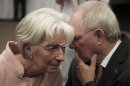
German Finance Minister Wolfgang Schuble, right, talks to the Managing Director of IMF Christine Lagarde prior of the Informal European economic and financial affairs council in capital Nicosia, Cyprus, Friday, Sept. 14, 2012. European finance ministers are gathering in Cyprus for two days of discussions about the debt crisis and the latest developments in Greece and Spain. (AP Photo/Dimitri Messinis)Greece may be given some more breathing room to meet its bailout commitments but no more money, European finance ministers indicated Friday as they gathered in Cyprus for a top-level meeting.


READ THE ORIGINAL POST AT news.yahoo.com

Thursday, September 13, 2012

Friday, July 20, 2012

Euro crisis deepens as time starts to run out for Spain's banks and regions

Spain drags the eurozone closer to the edge of collapse despite winning the backing of finance ministers from the single currency's major economies for a €100bn bank rescue fund

Spain dragged the eurozone closer to the edge of collapse despite winning the backing of finance ministers from the single currency's major economies for a €100bn (£77.8bn) bank rescue fund.

Concerns that Madrid is running out of options to bring down the debts of its ailing banks and bankrupt regions sent the country's borrowing costs soaring above 7.2% – a rate seen as unsustainable for a country that cannot devalue its own currency and is suffering a lengthy double-dip recession.

The bank bailout had been supposed to push down the country's borrowing rates, but the country's problems continue to mount. On Friday the region of Valencia was forced to turn to the Spanish central government for cash help.

That move, together with a downgrade of Spanish bonds to junk status by the credit ratings agency Egan Jones, saw the Madrid stock market suffer its biggest one day fall for two years.

Markets in London, Paris and Frankfurt followed suit with the FTSE 100 falling 1% to 5651. The euro crashed to historic lows against several currencies. Against the pound it fell to 77.72 pence, marking its lowest since the aftermath of the Lehman Brothers collapse in October 2008.

The prospect of Spain standing near the exit to the eurozone with Greece and Portugal had seemed outlandish only a few weeks ago, after eurozone leaders agreed to press ahead with more co-operation and a rescue for Madrid that targeted its banks.

Stock markets climbed and solvency fears eased after the summit, which many saw as provided a lengthy breathing space for politicians to work out a broader rescue package. But the shortcomings of the agreement have once again undermined renewed confidence in the eurozone and sent the bond yields of several countries higher, including Spain and Italy.

Comments by German officials added to the febrile atmosphere with hardliners questioning the eurozone's ability to carry on while southern European countries wrestled with major reforms and public spending cuts.

The Spanish government said a predicted rise in GDP next year of 0.4% had proved optimistic, and the economy would suffer another year of recession. The new forecast that the economy will contract by 0.5% shocked analysts, who said a raft of austerity measures would delay a recovery for several years.

Mariano Rajoy, the leader of Spain's right-wing government, has pushed through €65bn (£50.6bn) of spending cuts and tax rises to meet deficit targets set by Brussels, which are widely blamed for pushing the economy back into recession for another year.

Shortly before the bank bailout was agreed by eurozone ministers on Friday, the Valencia regional government admitted it could no longer fund itself on the markets and requested what is, in effect, a bailout by the Spanish government. Regional governments deliver the key parts of the welfare state, including health, education and social services.

Eastern Valencia said it was asking for central government help as it could not refinance loans that must be paid off this year. Regional vice president José Ciscar did not say how much was needed. "Like other regions, Valencia is suffering the consequences of liquidity restrictions in the markets," he said.

It will become the first of Spain's 17 semi-autonomous regions to tap a new, week-old €18bn (£14bn) fund designed to provide them with liquidity. The fund is part-financed with a loan from the state-owned lottery company.

Valencia, which has long been run by Rajoy's PP, is emblematic of Spain's current crisis. A property crash has hit both regional government income and the region's banks, with its three main banks having to be rescued. Local politicians, meanwhile, have a growing reputation for corruption and frivolous spending.

Valencia mopped up a quarter of the €17bn (£13.2bn) of extra money made available by central government in April to pay a backlog of regional government bills.

Just as Rajoy's government refuses to call the European rescue fund money a bailout, so Valencia's government insisted its request for special funding should not be described as one. "Valencia is signing up to a financing mechanism which other regions will also need in the coming days, without any further measures," Ciscar said.

Last year the regions not only failed to meet government-set deficit reduction targets, but actually increased their joint deficit. Rajoy's government has passed legislation allowing it to take direct control of the finances of regions that stray too far off target.

Analysts believe most regions will miss this year's 1.5 percent deficit target. The government last week asked at least eight of them to revise their 2012 budgets, threatening to take over the finances of some of them.

Analysts at Capital Economics said Spain had suffered a debilitating exodus of funds from its banks and a sharp detioration in its own funding position. As the reliance of the Spanish government on its own banks for funding grows (while the banks themselves are relying on the ECB), so the likelihood of Spain requiring a full-blown sovereign bailout grows too.

European leaders pleaded for calm after signing the final agreement to lend Spain €100bn of funds to underpin its banks.

European Central Bank executive Benoît Cœuré said at a conference in Mexico that it was startling to see international investors fearful of getting their money back from members of the single currency.

However, he said the fundamental measures of economic success were stronger in the eurozone than other developed areas. The eurozone's annual deficit in 2012, he pointed out, is expected to be 3% compared to 8% in the US, and 10% in Japan. He said the eurozone's total public sector debt will reach 90% at the end of the year compared to 106% in the US and 235% in Japan.But his comments were largely ignored as Mariano Rajoy's right wing government went back into crisis mode.


guardian.co.uk © 2012 Guardian News and Media Limited or its affiliated companies. All rights reserved. | Use of this content is subject to our Terms & Conditions | More Feeds


READ THE ORIGINAL POST AT www.guardian.co.uk

Monday, June 18, 2012

G20 summit: Barroso blames eurozone crisis on US banks

EC president says European leaders have not come to Mexico to receive lessons on how to handle the economy

The opening day of the G20 summit was threatening to deteriorate into a fractious row between eurozone countries and other non-European members of the G20, notably the US, as EU commission president José Manuel Barroso insisted the origins of the eurozone crisis lay in the unorthodox policies of American capitalism.

As Europe's leaders came under intense pressure to act decisively to cure the euro's ills, and a campaign gathered pace to relax some of the austerity programmes laying waste to countries burdened with unsustainable debt levels, Barroso insisted that Europe had not come to the G20 summit in Mexico to receive lessons on how to handle the economy.

When asked by a Canadian journalist "why should North Americans risk their assets to help Europe?" he replied: "Frankly, we are not here to receive lessons in terms of democracy or in terms of how to handle the economy.

"By the way this crisis was not originated in Europe … seeing as you mention North America, this crisis originated in North America and much of our financial sector was contaminated by, how can I put it, unorthodox practices, from some sectors of the financial market."

After the Greek election at the weekend, which may have shifted the terms of the debate over how to shore up the euro, world leaders meeting in Mexico focused on the European crisis amid strong signs of big trouble brewing in Spain.

Madrid's 10-year cost of borrowing went through the 7% barrier on the bond markets for the first time in the single currency era, the level at which borrowing becomes unaffordable. The Spanish government demanded intervention from the European Central Bank.

Spain's prime minister, Mariano Rajoy, is expected to ask for up to €100bn in eurozone bailout funds for Spain's stricken banks at a meeting of eurozone finance ministers in Luxembourg on Thursday, senior Eurogroup sources said. Voicing exasperation with the European response to the debt crisis, Robert Zoellick, the outgoing American head of the World Bank, warned the G20 summit in Mexico of a growing rift between the Europeans in charge of the bailouts and the IMF.

"The world's waiting for the Europeans to say what they want to do," said Zoellick. He predicted a showdown between the IMF and Europe by the end of the summer in the absence of any decisive action.

Barack Obama was expected to press Germany's chancellor, Angela Merkel, in Mexico on Monday night on the issue of eurobonds – the pooling of liability for single currency countries' debt. But there is no chance of Merkel agreeing to underwrite the debt of other European countries for the foreseeable future.

Fresh from his victory in the Greek election, the centre-right leader, Antonis Samaras, promptly tabled demands for a softening of the draconian austerity programme that Greece has to implement for the eurozone bailout.

Samaras, the prime minister-designate pledged to stick broadly to the Greek bailout terms but added: "We will simultaneously have to make some necessary amendments to the bailout agreement, in order to relieve the people of crippling unemployment and huge hardships."

Politicians and officials in Brussels and Germany appeared to suggest that the new Greek leader's demands could be at least partly satisfied by extending the repayment schedule on the bailout loans or lengthening the target deadlines for cutting the budget deficit.

There were also reports that the terms underpinning Ireland's bailout could also be relaxed, giving Dublin a much longer repayment schedule on the loans. The talk of rescheduling the Greek bailout terms surfaced quickly on Sunday night, with the German foreign minister, Guido Westerwelle, suggesting the Europeans could alter the timings. That triggered a row in Germany among the political class over the pros and cons of going easier on Greece.

In Brussels, the respected Bruegel thinktank said: "It is now increasingly clear that the [Greek] programme is severely off track. The [Samaras] victory doesn't change this fact and it has become unavoidable to open a discussion about the shape and form of a new Greek programme. This is a fact now broadly acknowledged by policymakers and in particular by German officials who have openly discussed the possibility of stretching fiscal targets."

Martin Schulz, the German social democrat who presides over the European parliament, added: "The new Greek government will be able to count on our constructive cooperation in possible fine-tuning of its reform strategy and economic targets. If Greece sticks to its commitments, the EU can examine what could be done further to solve the crisis."

From Mexico, however, Merkel appeared to dismiss any easing of the Greek conditions. "The new Greek government has to implement the commitments entered into by the country. The programme framework has to be kept."

The eurogroup source said that Samaras was expected to show up in Luxembourg on Thursday for the meeting of eurozone finance ministers which will grapple with Spain and how to respond to the Greek election results.


guardian.co.uk © 2012 Guardian News and Media Limited or its affiliated companies. All rights reserved. | Use of this content is subject to our Terms & Conditions | More Feeds


G20's relief at Greek pro-bailout vote is short-lived


Globe and Mail

G20's relief at Greek pro-bailout vote is short-lived
San Jose Mercury News
LOS CABOS, Mexico -- World leaders relief at Greek voters rejection of an anti-bailout government that could have forced the country s exit from the European ...
Greek election result spares leaders real-time fiscal firefightingGlobe and Mail
Obama calls Greek elections 'positive'Fox News
Sigh of relief at G20 summit over Greek electionCBS News

all 2,738 news articles »

Sigh of relief at G20 summit turns to angst

Mexican soldiers patrol the beach of San Jose del Cabo in Mexico's Baja Peninsula, Sunday, June 17, 2012. The G-20 summit starts in Los Cabos on Monday. (AP Photo/Eduardo Verdugo)World leaders' relief at Greek voters rejection of an anti-bailout government that could have forced the country's exit from the European currency union had evaporated by early Monday on the continued severity of Europe's economic problems.


Thursday, June 14, 2012

Spain issues dramatic messages of impending eurozone doom

Spain's foreign minister, José Manuel García-Margallo, said the EU's future would be played out in days or perhaps even hours

A panicky Spanish government issued dramatic messages of impending doom for the eurozone on Thursday as its borrowing costs reached unsustainable levels and foreign minister José Manuel García-Margallo claimed that the EU may need to act within hours.

"The future of the European Union will be played out in the next few days, perhaps in the coming hours," he said, according to Spanish press reports.

The foreign minister, who was speaking as Spain's long-term borrowing costs hit an unsustainable 7%, warned that other European countries would suffer dreadfully if they let Spain fall. ''If the Titanic sinks, it takes everyone with it, even those travelling in first class,'' he said, in a warning clearly aimed at Germany and other eurozone countries.

The interest rate on the country's benchmark 10-year bonds briefly hit 7% on Thursday, its highest level since the country joined the euro in 1999, after the ratings agency Moody's downgraded Spain's sovereign debt to just one grade above ''junk" status.

Moody's said the downgrade was due to the offer from eurozone leaders of up to €100bn (£81bn) to Spain to prop up its failing banking sector adding considerably to the government's debt burden.

García-Margallo's comments contrasted with those of finance minister Luis de Guindos, who called for calm during an inevitably volatile period while Europe prepares to make key decisions on its future and waits to see how Greece votes on Sunday.

"It is not a situation that can be maintained over time … and I am convinced that we will continue to take more measures in the coming days and weeks to help bring it down," De Guindos told reporters, referring to Spain's borrowing costs, after senior cabinet members had met prime minister Mariano Rajoy.

Government sources said that the EU president Herman von Rompuy was set to meet Rajoy, Germany's Angela Merkel, Italy's Mario Monti and Frrance's François Hollande in a five-way meeting during the G20 meeting in Mexico on Monday.

Barack Obama, who has been pressuring eurozone countries to act quickly in order to sort out the debt crisis, was also expected to meet the five leaders in Mexico. David Cameron may also join the meeting.

The EU competition commissioner, Joaquín Almunia, was expected to get a chilly reception in Madrid on Friday when he flies in to meet Rajoy to discuss the bailout of the country's banks.

Rajoy's conservative People's party (PP) has called for Almunia, a Spanish socialist, to resign after he warned that some Spanish banks may have to be liquidated.

"Rajoy is head of the People's party but, most importantly, he is the prime minister and in that role he will not be asking for Almunia's resignation," a government source said.

Almunia will be in charge of the EU inspectors who oversee the restructuring of the Spanish banking sector. The budget minister Cristóbal Montoro has called them the "men in black".

Spain will next week be able to say how much of the €100bn its banks really need. Rajoy has said he will wait for the results of two independent valuations of Spanish bank assets before deciding on a final sum.

Those reports are due by 21 June, but Reuters reported that officials in Madrid already knew the contents of the reports and that Rajoy would have the figures with him when he travelled to Mexico.

The final figure was likely to be between €60bn and €70bn, according to Reuters, though officials in Madrid refused to confirm the amount.

Officials said that Spain wanted the banking loans to be delivered as soon as possible. ""No one is more interested than us in there being absolute clarity in our banking sector, and as soon as possible," a government source said.

Madrid is pinning its hopes of avoiding a wider bailout of the country on an EU summit to be held at the end of this month.

"The government is seeking a declaration of the irreversibility of the single currency and of its willingness both to defend that and to create the necessary mechanisms," a government source said.


guardian.co.uk © 2012 Guardian News and Media Limited or its affiliated companies. All rights reserved. | Use of this content is subject to our Terms & Conditions | More Feeds


Wednesday, June 13, 2012

$125 Billion Spanish Bailout, And Guess Who Gets the Bill


The Guardian

$125 Billion Spanish Bailout, And Guess Who Gets the Bill
CNBC.com
After clinching a $125 billion bailout for Spain's banks, Prime Minister Mariano Rajoy flew to Poland on Sunday for the Spanish team's soccer match, declaring “this matter is now resolved.” On Tuesday, Spain's long-term borrowing costs soared to their ...
European shares inch up, capped by Spanish crisisEconomic Times
FOREX-Euro edges lower before Italian debt sale, Greek voteReuters
World stocks mixed as Spain, Italy worry investorsBusinessWeek
Reuters India -Los Angeles Times -The Guardian (blog)
all 6,386 news articles »

Spain sees borrowing costs rise despite bank bailout plan


Los Angeles Times

Spain sees borrowing costs rise despite bank bailout plan
Los Angeles Times
LONDON — Skepticism over a bailout plan for Spain's flailing banks drove the country's borrowing costs Tuesday to their highest level since Madrid adopted the euro, adding to fear that Europe's stubborn economic and financial crisis is entering a ...
FOREX-Euro stuck in range before Italian debt sale, Greek voteReuters
Full-Scale Bailout for Italy, Spain in 6 Months: Egan-JonesCNBC.com
Asian markets rise on higher US market, Europe worries capEconomic Times
Reuters India -BusinessWeek
all 6,440 news articles »

Spanish bank bailout already failing? Nation's borrowing costs soar close to 7%

The interest rate on Spanish 10-year bonds rose to 6.6 per cent - near to the 7 per cent level that forced Greece, Ireland and Portugal to request the rescue of their public finances.